
Have you ever wondered why the sky’s colors around sunrise or sunset look the way they do? And which is better, sunrise or sunset? Look no further, the answers are right here!
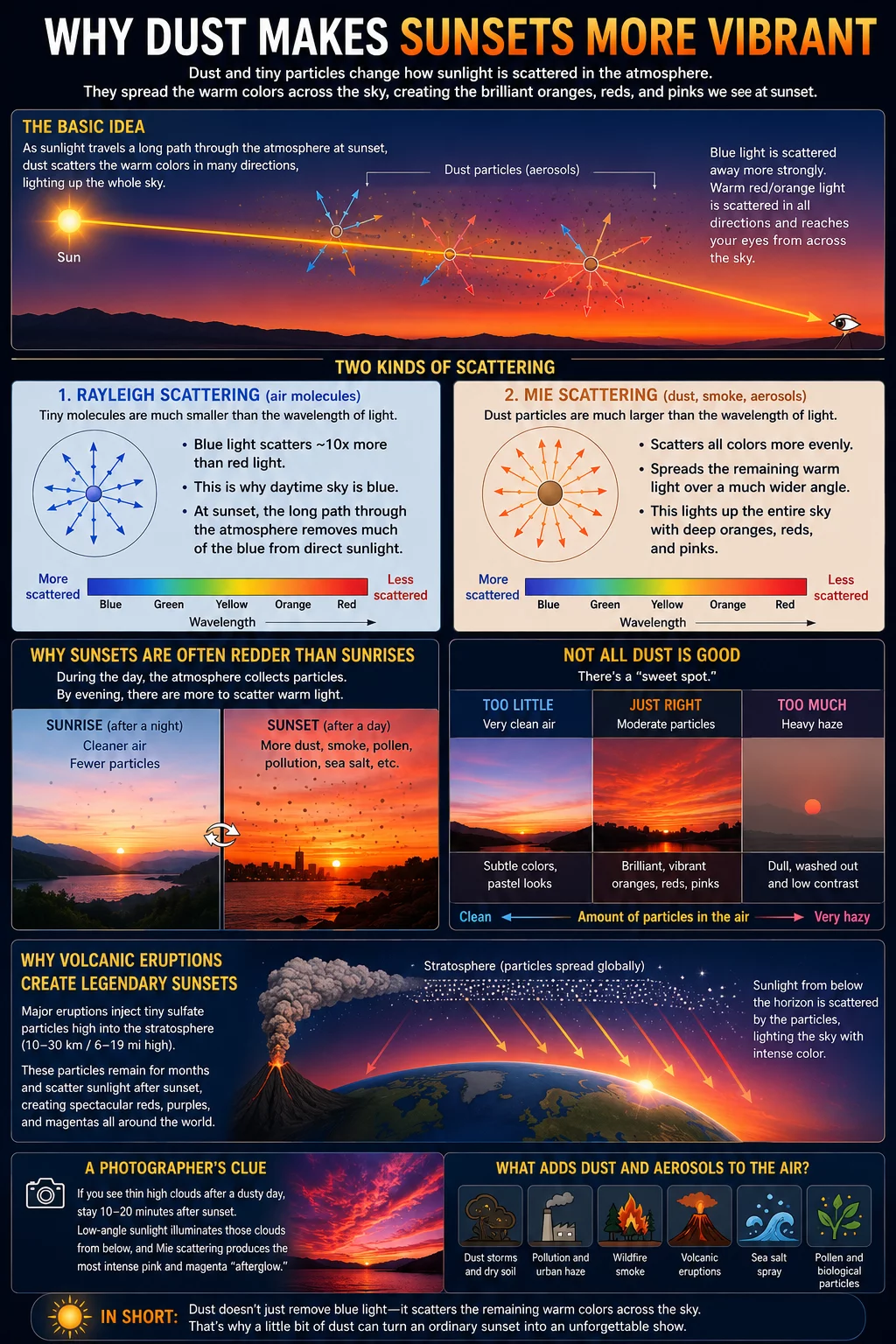
First let’s understand where the colors of the sky come from. It is all about the way the light from the sun bounces (scatters) off small particles in the atmosphere, such as tiny molecules, dust, droplets, smoke, pollution, plus other small particles suspended in the air. If there were no scattering, the sky would essentially be transparent. You would see right into the dark universe that surrounds us, as you do at night, except you would also see the sun as a very bright, whitish spot!
Sunlight mostly is white. But white light is not a pure color, it is the sum of many colors. It turns out that the blue component of white light scatters the most off the tiny air molecules. And that is why the daytime sky is blue! The other colors scatter more (and are absorbed) or less and essentially pass right through, giving the sun the color you see when you look straight at it, which of course you should not!
The scattering of the sun’s light also is the reason for sunrise and sunset’s beautiful colors. When the sun is close to the horizon, the light has to travel a longer path through the atmosphere. Since the blue component of the sun’s light scatters the most, it is absorbed before it reaches the observer. The reddish colors, however, are able to pass through, so that the sky close to the horizon has that beautiful warm color we all love! I will go into a lot more detail in a future post.
But there is more to it. Dust, smoke, humidity and other small particles, all of which are considerably larger than air molecules, do not really differentiate so much between the colors they scatter. But they scatter the light over a wider angle. Around sunrise our sunset, since the bluish colors already have been scattered away by the air molecules, because of the long path that light has to travel, the remaining warm colors are scattered over a wide angle by the larger particles, creating an especially vibrant, glowing orange and red sky.
Now which is better, sunrise or sunset? In principle, they should be identical except that things happen in the opposite order. But there are key differences, which depend a lot on atmospheric conditions and how they change over time. Since the color of the sky depends on the way light scatters off molecules and small particles suspended in the air, this of course will play a role in any visual difference between sunrise and sunset.
Over the course of the day, the atmosphere accumulates dust, pollution, smoke and other small particles. As explained above, this will result in a more vibrant sky. So sunset is better, right? Well, as always there are pos and cons:
Advantages to sunrise:
- Overnight, dust, smoke and other small particles often settle, producing clearer views and sharper distant mountains than at sunset.
- Color transitions are more fine grained due to the generally cleaner air.
- You may encounter foggy conditions which of course can make for stunning scenes.
- Calmer conditions in general, great for beautiful reflections!
- Lack of people! These are the precious moments you can experience the beauty and serenity of nature all by yourself!
Advantages to sunset:
- More vibrant oranges and reds, due to the accumulation of small particles in the atmosphere.
- Convenience! You don’t have to get up well before dawn to capture those beautiful colors.
- Potentially more interesting cloud formations due to convection over the course of the day.
So which is better?
My answer: Don’t miss either! Both have so much to offer. The beauty about photography is that nature provides us with endless surprises. The more often you get out there, the more likely you are likely to experience that unforgettable moment. If I had to choose? It would be sunrise. Because of the experience: The crisp, fresh air, the beginning of a new day, but most importantly, the precious time where I am all by myself surrounded by nature’s endless, calming beauty, more important than the image itself.
Join us on our highly acclaimed photography adventures to some of our planet’s most spectacular wildernesses and benefit from a small group size, a highly effective learning experience and exceptional personal attention! To find out more, please visit here!