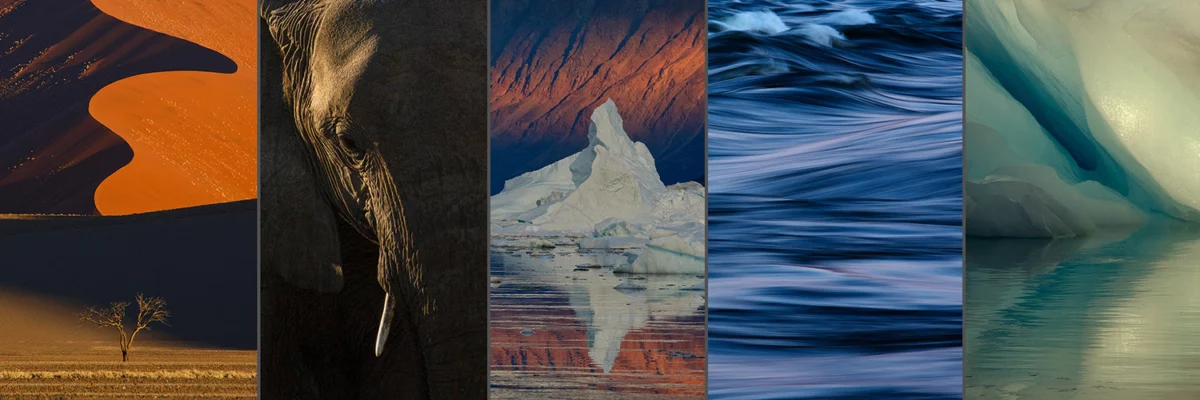
As described in my previous post, you probably have heard that using a telephoto lens compresses the distance between objects and gives a better sense of scale.
But is that an illusion?
The telephoto lens does not actually compress distances or enhance relative scale, but it does change perspective.
In fact, every focal length gives a different perspective, but it is more obvious when you use the telephoto, since the perspective differs substantially from the shorter focal lengths of the wide angle or the human eye (effectively around 50 mm).
So how does it work?
Relative size, i.e. sense of scale
The apparent size of an object is inversely proportional to the distance from the camera or viewer. For example, an object photographed at 10 times the distance is 1/10 the apparent size.
Imagine photographing a person standing in front of a mountain and your image includes both the person and the whole of the mountain
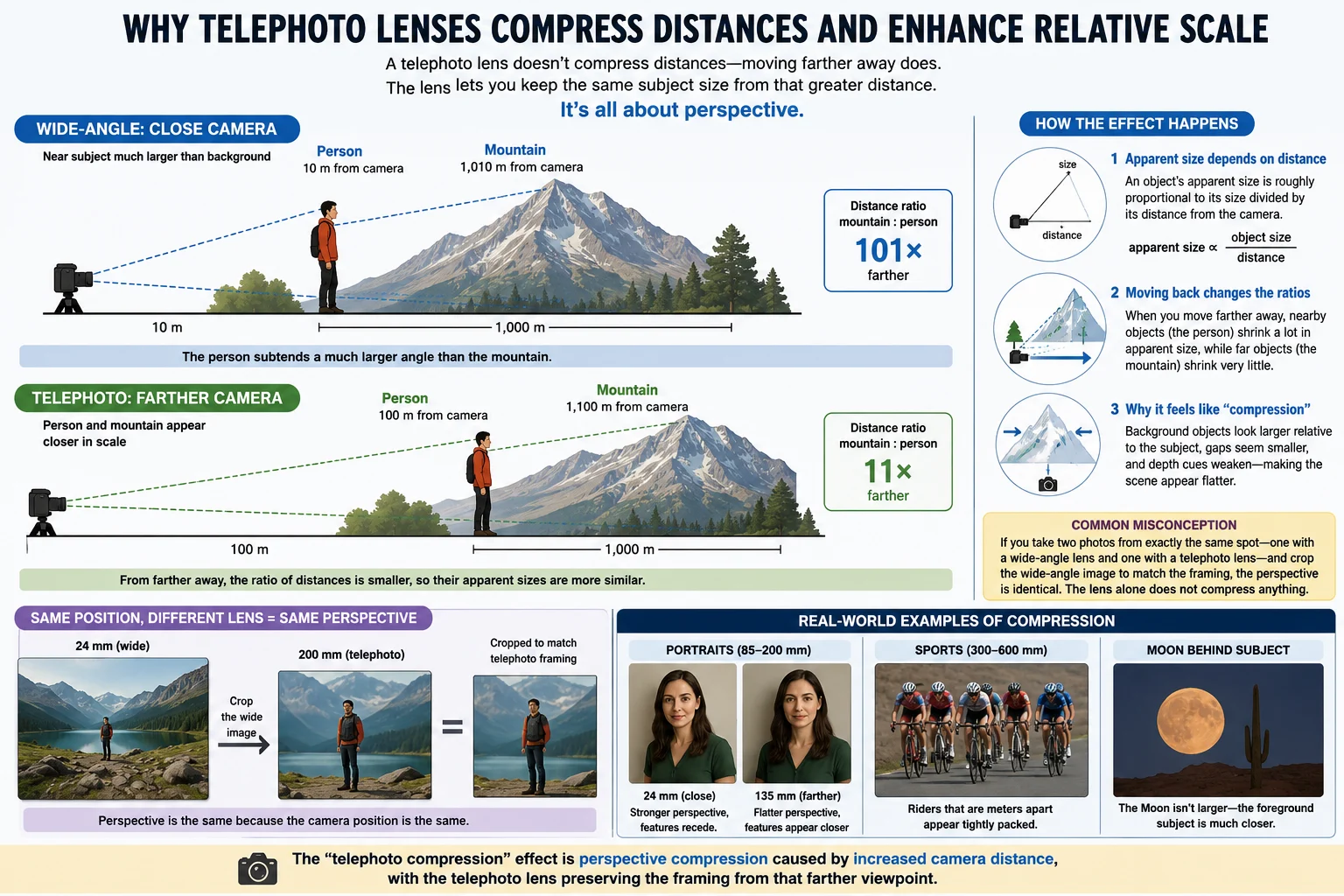
Assume the person at 10 m and the mountain at 1000 m from the camera. If you use a telephoto, and you want to keep the same framing, you need to move considerably further away. For example, you move back until the person is at 100 m. The apparent size of the person now is about 10 times smaller. The mountain, on the other hand, now is at 1100 m. It is only 1/10 further from the camera than it was initially and its apparent size will reduce by only 1/10. The person now looks much smaller relative to the mountain, and this gives a better sense of scale. The below infographic explains it all!
Where does the compression come from?
The sense of compression of distance is due to the fact that with a telephoto you would be standing further away, if you wanted to keep the same framing.
Going back to the above example. If the person is at 10 m and the mountain at 1000 m from the camera, then the mountain is about 100 times further than the person. If you move back 100 m, then the person is at 100 m and the mountain at 1100 m. Now the mountain is only 11 times further from the camera than the person. The relative distances are much smaller. Things seem closer to each other.
And there you have it! I hope you found this explanation useful!